 Precious Okoro
A field guide for content designers pivoting into AI, from someone in the middle of the pivot.
I’m building a tool right now that turns my editorial standards into software. It reviews writing against my rules before the writing ships. I’m not writing this from a trend report or a conference stage. I’m writing it from inside the work, with the parts that are breaking still open on my screen.
So let me start with the thing I wish someone had told me sooner. If you’re a content designer watching agentic AI arrive and quietly wondering whether your craft is about to be automated away, you have this backwards. Agentic content design isn’t a new profession you have to start from zero. You’ve already done most of it. The medium changed. The work didn’t.
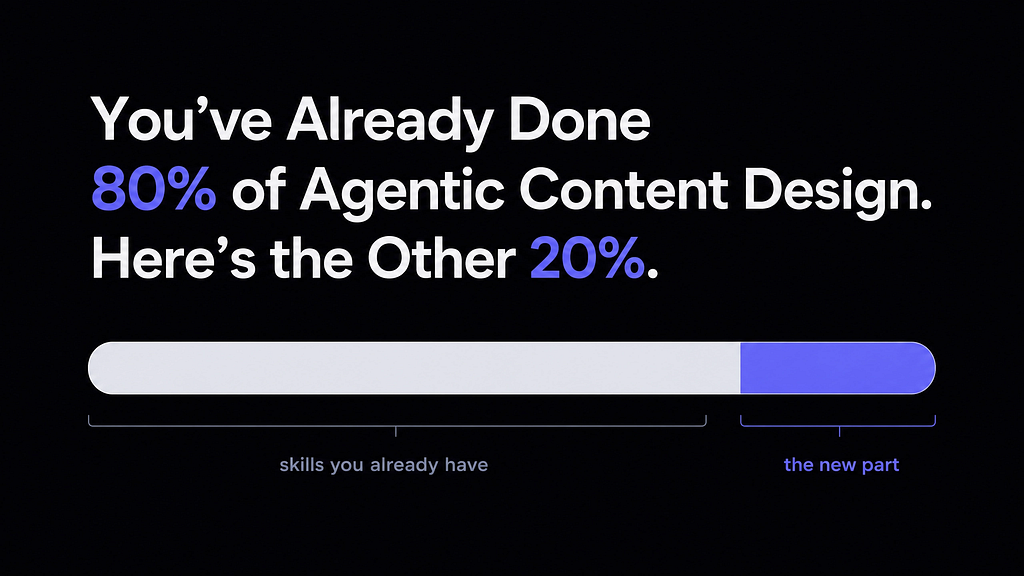
The short version: Most of agentic content design is the content design you already do: audience, systems, clarity, and failure. About 20% is new: prompt systems, eval sets, guardrails, and context as information architecture.
This is the same argument I made in my piece on why agent experience starts with content design. That was the case to the industry. This is the case to you, the content designer deciding whether your skills still count. Here’s the map of what you own, and what you still have to learn.
The 80% You Already Own
The panic assumes content design was about typing. It wasn’t. The words were always the visible tip of something larger, and that larger thing is exactly what agentic AI demands.
You already think about audience. You never wrote for “users” in the abstract. You wrote for one person with a goal, a context, and a limited amount of patience. Designing for an agent is the same discipline. The agent has to read intent, and someone has to decide what it does when that intent is unclear. That someone is you.
You already think in systems. You didn’t design one screen. You designed the rules that made a hundred screens feel like one product. Building agent systems is that same instinct at a different scale, with orchestrators routing to sub-agents, each needing exactly the right context to behave.
The industry has started calling this context engineering. The quiet truth under the buzzword is that content designers have been practicing it all along.
You already design for failure. You wrote the error message, the empty state, and the moment the payment didn’t go through. You know trust is won or lost at the edges, not in the happy path.
Agentic AI is one long series of edges. An agent that acts on its own will be uncertain, will be wrong, and will occasionally do something a person didn’t expect. Every one of those moments is a content design problem you have already spent years solving.
That’s the 80%. Audience, systems, clarity, and grace under failure. Carry it with you. It isn’t a nice-to-have in this new world. It’s the foundation the new world is built on.
The 20% That’s Actually New
The honest part is that 80% is not 100%, and the gap is real. Here’s what sits inside it, and none of it is beyond you.
Prompt Systems, Not Prompts
A prompt is a single instruction you type and tweak when it misbehaves. That isn’t the skill. The skill is the prompt system, the connected set of templates, tone frameworks, and instructions that guide an agent through real work consistently.
The era of the one clever prompt is already ending. What replaces it looks a lot like what you already do. You build the template that keeps every output on standard. You write the tone framework that makes the agent sound like the brand instead of a machine. You decide what the system says at its edges.
This is design, not wordsmithing. It rewards the person who thinks in reusable structure instead of one-off lines.
Eval Sets, or Defining What Good Even Means
Here’s the skill that changed how I see my own craft. In content design, quality often lived in your head. You knew a line was off, you fixed it, and the knowing stayed invisible.
Agentic systems won’t let you keep quality invisible. You have to define it. The current practice is rubric-based evaluation, where you write out explicit criteria, a scale, and a description of what each level means, then use a strong model as a judge to score writing against it. It’s the same move a good editor makes, made legible enough that a machine can run it.
This is the heart of the tool I’m building, and building it taught me something uncomfortable. Half my rules held up the moment I had to write them down. The other half turned out to be preferences I’d been calling principles for years.
Turning your judgment into an eval set doesn’t just teach the machine. It audits you. That’s the work, and it makes you better at your own craft.
Guardrails and Failure Design
You know how to write an error message. Designing agent guardrails is that skill turned up to full volume.
The strong patterns emerging in the field come down to a few ideas you’ll find familiar. Calibrate expectations up front, so a person knows what the agent can and cannot do. Keep the person in control, with reversible actions by default and clear confirmation where things can’t be undone. Make the system’s reasoning visible, so trust rests on transparency instead of hope.
If you want to see how much of this is already documented design work, spend an hour in Emily Campbell’s Shape of AI, a pattern library that catalogs how real products handle AI interaction across categories like trust indicators and tuners. None of it is engineering. It’s content and interaction design applied to a system that can act, and you’re more prepared for it than any engineer on the team.
Context as Information Architecture
The last piece is the one that reframed everything for me. A context window is not a container you fill with everything the model might need. It’s a page, and every page has an information architecture whether you designed it or not.
What goes first. What sits beside what. What gets cut, and what the model sees when its attention runs thin. Those are the same decisions you make laying out a screen. Order is meaning. Proximity is emphasis.
When you give an agent too much at once, the important instruction doesn’t break. It just gets buried, and buried is the same as gone. If you can architect information for a human, you can architect it for a model. Most content designers are already doing this and simply haven’t named it yet.
The Flow You’ll Be Designing
One practical shift is worth naming plainly, because it changes what your deliverables look like.
You used to map a flow as screens. A to B to C, every path drawn, every edge known. Agentic systems don’t move like that. The real flow is intent, then context, then a tool call, then success or failure, then a replan. The agent chooses the path in the moment, and it can take one you never drew.
So you stop designing screens in a line and start designing the moments between an agent’s decisions. The moment it interprets a request. The moment it acts. The moment it fails and has to say so. The moment it changes course and a person needs to understand why. Those moments are where trust is built or lost, and they’re yours to design.
How to Start Agentic Content Design This Week
You don’t need permission or a new job title to begin. Pick one agent or AI feature you already touch.
Write down the rules you’d use to judge its output, the way you’d edit a junior writer. That’s the start of your first eval set. Look at one of its prompts and ask whether it’s a system or a single instruction, then turn it into a template. Find the point where it fails and design what it should say there.
That’s agentic content design, and you’re already equipped for most of it.
The field isn’t shrinking. It’s moving up a layer, to where the decisions are bigger and harder to see. The content designers who thought the job was typing will feel replaced. The ones who understood the job was judgment will find their judgment matters more than it ever has.
Key Takeaways
- Agentic content design is roughly 80% skills content designers already have: audience thinking, systems thinking, clarity, and failure design.
- The new 20% is prompt systems, eval sets, guardrails, and treating the context window as information architecture.
- Context engineering is a new name for a decision content designers already make: what information goes where, and what gets cut.
- Rubric-based evaluation forces you to make your editorial judgment explicit, which improves the judgment itself.
- You can start this week on an AI feature you already touch, no new title required.
Frequently Asked Questions
Is content design being automated by AI? The typing part is being automated. The judgment part, deciding what an agent should say when it’s unsure, wrong, or acting on someone’s behalf, is not. That judgment is the core of content design, and it matters more in agentic systems, not less.
How do content designers move into AI? Start from what you already own: audience, systems, clarity, and failure design. Then add the four new skills: building prompt systems instead of single prompts, writing eval sets, designing guardrails, and treating the context window as information architecture.
What is context engineering for content designers? Context engineering is deciding what information an agent gets, in what order, and what to leave out. It’s the same skill as laying out a screen, where order carries meaning, and the buried instruction is as good as gone. Content designers already do this.
What is rubric-based evaluation? It’s writing explicit criteria, a scale, and a definition of each quality level, then using a strong model as a judge to score outputs against them. For a content designer, it’s the act of turning invisible editorial judgment into something a machine can run.
How do I start in agentic content design with no AI experience? Pick one AI feature you already use. Write the rules you’d judge its output by, turn one of its prompts into a reusable template, and design what it should say when it fails. That’s the work, at small scale.
I’m building this tool in the open, and I’ll keep sharing what I learn as I go, the wins and the parts that break. If you’re making this pivot too, follow along. I think you’ll recognize the fight, and I think you’ll be surprised how much of it you already know how to win.
Sources:
Emily Campbell, The Shape of AI;
Agent Experience Starts With Content Design, Precious Okoro.