 Precious Okoro
Six emerging trust patterns for AI agents, and the writing decisions that make them work.
An AI agent doesn't just answer you anymore. It acts. It books the flight, sends the message, moves the money, changes the file. And the moment software stops suggesting and starts doing is the moment trust becomes the whole game.
The good news is that the field is starting to move from principles to patterns. Over the last year, designers and researchers have begun identifying repeatable ways to keep people informed and in control of systems that can act on their behalf. The clearest articulation comes from Smashing Magazine's framework for agentic UX, and similar ideas appear in the World Economic Forum's work on designing for trust and across other emerging work on human-agent interaction.
These recurring AI agent trust patterns aren't standardized yet, and part of an official framework, but the same trust problems keep surfacing.
Every one of these patterns is also a writing decision. The dial, the preview, the audit log, and the confirmation button are containers. What fills them is language, and that language determines whether a person can actually understand the control they're being given.
So this is the Content designer's version of the toolkit: six recurring trust patterns for agentic systems, and the specific writing decision that makes each one work.
TLDR: The six patterns are Intent Preview, Autonomy Dial, Decision Rationale, Confidence Signal, Action Audit and Undo, and Escalation Pathway. They cover the agent action lifecycle: before it acts, while it works, and after it acts.
This is the Content designer’s toolkit version of the argument I made in [Agent Experience Starts With Content Design]. Bookmark it. You'll reach for it every time you build an agent that acts.
Before the Agent Acts
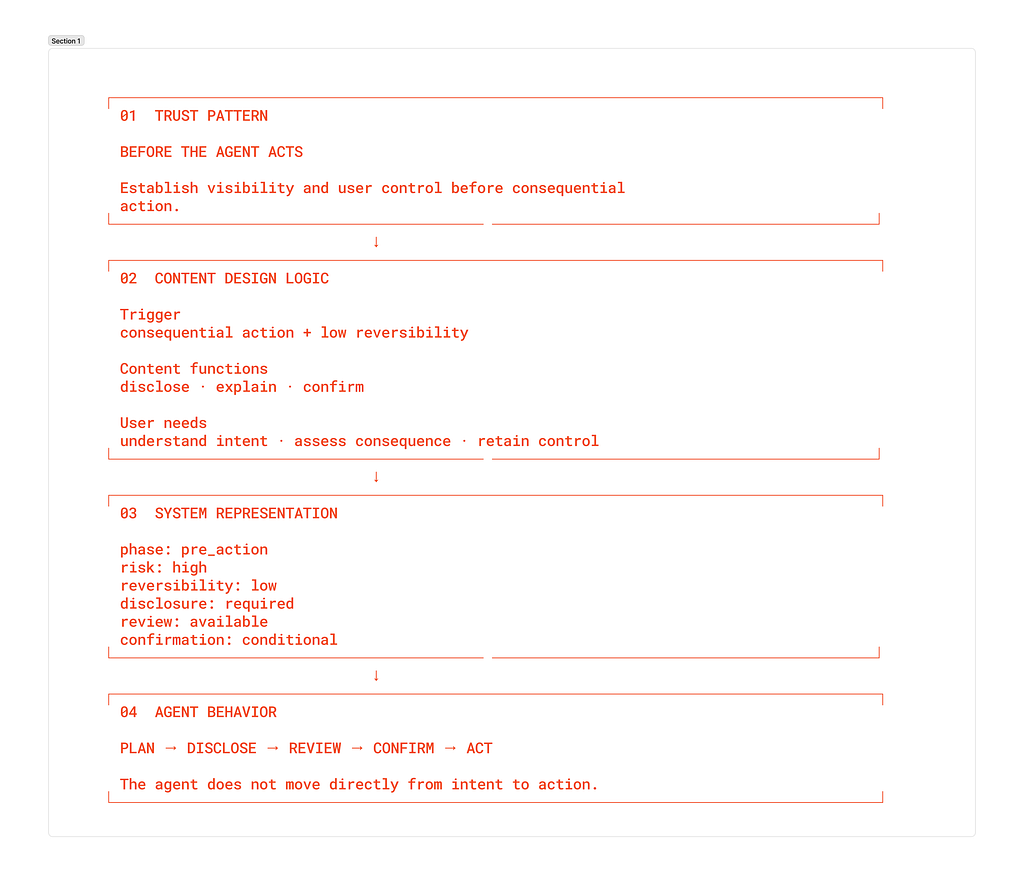
The first two patterns come into play before the agent takes any action it cannot easily reverse. This is where the agent makes its plan clear, establishes its boundaries, and gives the person a chance to understand what is about to happen while the stakes are still low.
1. Intent Preview
What it is: The agent shows you what it's about to do before it does it.
The writing decision: A preview only builds trust if a person can actually catch a mistake in it. Write a wall of detail and they rubber-stamp it without reading. Write too little, and they're approving blind. The craft is surfacing the one or two things most likely to be wrong, in plain language, at the top.
Before: "Ready to proceed with the requested action. Confirm?"
After: "I'm about to email the Meridian invoice to finance for $14,400. Send it?"
The second version puts the three things a person would actually want to catch, who, what, and how much, in the sentence itself. That isn't more copy. It's better-chosen copy for the agent experience.
Reach for it when: The action is consequential, irreversible, or expensive.
2. Autonomy Dial
What it is: The person sets how much latitude the agent has, from asking before everything to handling routine work independently.
The writing decision: The levels have to be named in words a human understands. "Level 3 autonomy" means nothing. The content job is translating a permission setting into a sentence about real behavior.
Before: "Autonomy: High / Medium / Low."
After: "Ask me before sending anything / Handle routine replies, ask about anything unusual / Run it all, just keep me posted."
The dial is the interface. Labels tell a person what they're actually agreeing to, which means you aren't just naming a setting; you're defining the boundaries of the agent's authority.
Reach for it when: The agent operates across a range of stakes and people need to tune how much authority it has.
While the Agent Works
The next two patterns matter while the agent is in the middle of the work.
At this point, the person needs to understand what the agent is doing and why, without having to decode the system or follow every step of its process.
3. Decision Rationale
What it is: The agent gives a meaningful reason for a decision it made.
The writing decision: Explain the decision, not the entire reasoning process. The World Economic Forum frames the goal as meaningful traceability, not full technical disclosure, and that distinction matters.
Dump every technical factor into the interface, and you've buried the point. The craft is deciding what a person needs to know to evaluate the decision, and cutting the rest.
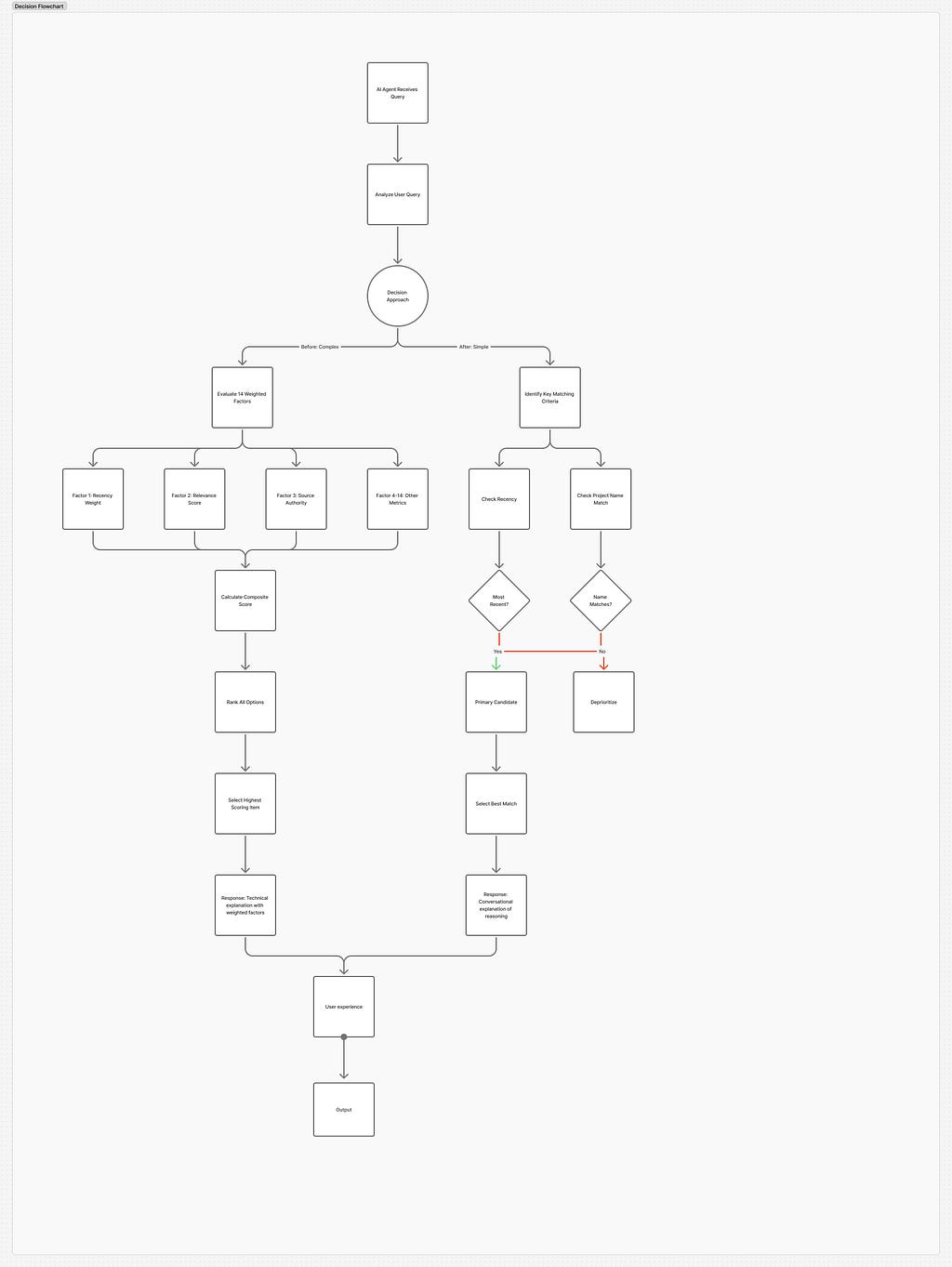
Before: "Selected based on 14 weighted ranking factors including recency, relevance score, and source authority."
After: "I picked this one because it's the most recent and it matches the project name you used."
Same decision. One version exposes machinery, the other explains the choice. The goal isn't to show people everything the system considered; it's to give them what they need to decide whether the choice makes sense.
Reach for it when: The agent makes a choice a person might reasonably question.
4. Confidence Signal
What it is: The agent communicates how certain it is, in a way that helps the person decide what to do next.
The writing decision: Confidence is not the same thing as a percentage. This is the one teams get wrong most easily, and it's worth its own piece, which I wrote on how AI should communicate confidence and uncertainty. A number like "72% confidence" looks precise, but precision isn't the same as useful information. The better question is what the person should do differently, since the agent isn't entirely sure.
Before: "Confidence: 72%."
After: "This is my best match, but the data is thin for this vendor. Worth a quick check before I proceed."
The second version doesn't just tell the person that uncertainty exists; it tells them what that uncertainty means for their next move. A useful confidence signal is information about the person's decision, not information about the model for its own sake.
Reach for it when: The agent's certainty genuinely varies, and the person's next action should depend on it.
After the Agent Acts
The final two patterns come into play after the action has been taken. They create a safety net for the moments when something needs to be checked, reversed, or handed over to someone else.
5. Action Audit and Undo
What it is: A readable record of what the agent did, paired with a way to reverse it when possible.
The writing decision: An audit log is only a trust feature if a human can read it. A raw event stream isn't accountability; it's noise. The craft is writing each entry as a plain sentence a person could understand a week later, and making the recovery action findable in words, not buried behind an icon.
Before: "14:32:07 POST /invoices/847/send status:200"
After: "2:32 pm: Sent the Meridian invoice to finance. Undo this."
The second version answers the questions that actually matter: what happened, when it happened, and what I can do about it.
Reach for it when: The agent takes actions with consequences a person may need to trace or reverse.
6. Escalation Pathway
What it is: The moment the agent reaches its limits, and either asks the person for help or hands the task to a human.
The writing decision: Make the handoff feel like a continuation of the workflow, not a system failure dumped in the user's lap. Escalation is where trust is most fragile, because something has already gone sideways. The words need to answer five simple questions: what happened, what the agent tried, why it stopped, who takes over, and what happens next.
Before: "Unable to complete request. Please contact support."
After: "I couldn't verify this payment, so I've stopped. I've flagged it for a human on the finance team, and they'll follow up today."
The second version doesn't pretend the system succeeded, and it doesn't make the person figure out what to do next. It explains what happened, shows that the agent deliberately chose to stop, and gives the person a clear next step. That's what a good handoff does.
Reach for it when: The agent hits its limits, and it eventually will.
The Rule Underneath All Six
Read back through the patterns and notice the shape. Every one has an interface half and a language half. The dial, the preview panel, the audit view, and the confirmation button are the visible mechanisms. The labels, the previews, the explanations, the log entries, and the handoff sentences are what make those mechanisms understandable.
The mechanism is the container. The language is what makes the mechanism usable.
That's why these are Content design patterns wearing UX clothing. You can implement all six correctly at the interface level and still lose the user, because the copy inside each one was written as an afterthought. The pattern is necessary, and the language is what makes it work.
This matters more with agents than it did with traditional interfaces, because the system isn't simply helping someone navigate software anymore. It's making decisions, taking actions, and sometimes deciding when it needs to stop. The content is part of the control system.
Start With Your Weakest One
You don't have to build all six at once. Pick the pattern your product handles worst right now.
Two are particularly easy for teams to get wrong: escalation, because failure copy is often written last and under pressure, and confidence, because teams reach for a percentage instead of doing the harder work of explaining uncertainty in words. Start there. Rewrite the sentence your agent shows when it fails, and the sentence it shows when it isn't sure. Then ask two questions of each one: can the person understand what happened, and can they tell what they should do next?
Those two changes may do more for trust than another feature ever will. The patterns are the map, but the words are the territory, and the words are yours to write.
Key Takeaways
- Six recurring trust patterns are emerging across agentic UX: Intent Preview, Autonomy Dial, Decision Rationale, Confidence Signal, Action Audit and Undo, and Escalation Pathway.
- They map to the agent action lifecycle: before it acts, while it works, and after it acts.
- Every pattern has an interface mechanism and a language layer, and the language is what makes the mechanism understandable and usable.
- Confidence should communicate what uncertainty means for the person's next action, not simply display a percentage.
- Good escalation copy explains what happened, what the agent tried, why it stopped, who takes over, and what happens next.
- You don't need to redesign everything at once. Start with the trust pattern your product handles worst.
If you build or write for AI products, pick the trust pattern your agent handles worst, its failure message, its uncertainty signal, or its action preview, and rewrite that one this week.
Sources
Smashing Magazine, "Designing For Agentic AI: Practical UX Patterns" (2026)
World Economic Forum, "How to design for trust in the age of AI agents" (2026)
designative.info, "Designing Human-Agent Interaction" (2026)
Agent Experience Starts With Content Design: Precious Okoro